Milesians

Milesians. Pre-Socratic, named for Miletus on Asia Minor coast across from Greece, 6th cent. BC. Thales, Anaximander, Anaximenes.

Anaximenes takes air to be the basic material stuff, while earth, fire, and water are formed out of it by condensation and rarefaction: fire is the least dense; air is denser than fire, water denser than air, and earth the most dense.

Anaximander takes the infinite or the indefinite (apeiron) to be the basic material stuff

Thales (some call him the first philosopher), he thought water was the basic stuff of nature.


Ethics Essay: for Peter Singer’s Coursera Class

Topic Three: Would you answer both these questions in the same way?  Why, or why not?
i.                Is a physician ever justified in withdrawing life-support, including a respirator, from an infant so premature that it cannot breathe on its own?
ii.               Is a physician ever justified in giving a lethal injection to a severely disabled infant?
To both questions, I would answer affirmatively, that there are indeed cases where a physician would be justified in withdrawing life support from a premature infant, or in the case of a severely disabled infant, in giving a lethal injection.  Of course, several conditions must be met to for this serious measure to be justifiable.  The infant in question must at least be in a state meeting three conditions:  the infant cannot survive without extreme and constant measures of support to sustain basic life functions, that there is no reasonable expectation of improvement of the infant and no expectation of improvement in medical science to alleviate the condition, and that continuing the life of the infant means extraordinary suffering for the infant and family.
The first case, where life support is withdrawn, is a type of passive euthanasia.  The second case, where a lethal means is used to terminate life, is active euthanasia. Both situations are cases for considering non-voluntary euthanasia, that is, where euthanasia is warranted but the subject is unable to make the decision.1 Since the decision cannot be made by the infant, there should be a procedure followed that euthanasia is warranted and agreed to by parents, the physician, and be some third party such as a medical ethicist or civil authority.  The cases of infants are different than those of adults not only in the necessity for outside consent, but because infants are not equal to adults the evaluation of the morality of the decision.  This is best clarified by Peter Singer, who writes, that in consideration of the wrongness of killing, “characteristics like rationality, autonomy and self-consciousness that make a difference. Defective infants lack these characteristics.  Killing them, therefore, cannot be equated with killing normal human beings….”2 
There are secondary considerations that should be given great weight.  Is the infant in a culture or in a religious hospital that forbids such a passive euthanasia?  Does the prevailing law of the locale or the protocols of the hospital allow or prohibit such action?  Will there be such enormous expense to continuing life support that may make the prolonged life unsustainable be the economy or the caregiver’s ability to sustain treatment?  Will the prolongation of life cause unbearable suffering on the part of the parents or caregivers, or, would the termination of life-support of the child cause unbearable mental anguish on the part of the parents?
Some might raise an objection claiming that all life, or all human life is sacred and must be maintained at all cost.  This position is extreme.  The life of some humans or potential humans is so diminished or defective or unbearable that it’s ending is not equal to the end of a fully adult, conscious, aware and pain-free life.
Giving a lethal injection to a severely defective infant can be justified, but requires some additional considerations.  Resorting to an active intervention to terminate life where the infant could survive with simple medical interventions could raise at least two objections.  The intention would be to kill, and traditional thinking about killing is that this act is inherently evil so that the permissibility test for the doctrine of double effect cannot me met.3 Additionally, there is a common sense and psychological aversion to actively killing an infant.  However, there can be two strong responses to these objections.   The severely defective infant is not a full human person in that there is no expectation of the development of rationality or a sense of self and the medical situation prevents any expectation of the development of autonomy.  Additionally, the result of either the passive or active intervention is death, so there is no difference at all in the most important thing to consider.  Furthermore, there is no “potential” humanity or “potential rights”, a value that ranks high for many.4
Some might argue that the parent’s or caregiver’s burden is not a secondary consideration at all, but is the most important and deciding factor.  The situation of an extremely defective infant sustained only by extreme means is not significantly different than a fetus.  Think about a position somewhat similar or analogous to that of Judith Jarvis Thompson, that no one has the right to use another person to sustain whatever life is available.  This would mean the parent’s rights to a full life unburdened by extreme emotional toll and financial burden of care of the infant.  However, if this is the primary concern, then we are giving little weight to the value of the admittedly defective infant or the serious moral implication of life or death considerations.  What is more, there is the danger of self-serving parents or medical caregivers who may be seeking relief of the burden of an infant whose condition does not warrant passive or active euthanasia.
1 definitions from Robert Young, “Voluntary Euthanasia,” The Stanford Encyclopedia of Philosophy (Fall 2010 Edition), Edward N. Zalta (ed.),http://plato.stanford.edu/archives/fall2010/entries/euthanasia-voluntary
2 Peter Singer, Practical Ethics, Cambridge, Cambridge University Press, 1979 ed., page 131.
3 Alison McIntyre, ”Doctrine of Double Effect,” The Stanford Encyclopedia of Philosophy, Edward N. Zalta (ed.).http://plato.stanford.edu/entries/double-effect/
4 “Potential Human, Potential Rights,” http://www.bbc.co.uk/ethics/abortion/child/potential.shtml, accessed 7Apr2014

Walkable City, How Downtowns Can Save America, One Step at a Time, Jeff Speck, 2012

I was pleased to see that the Lexington Herald-Leader today reviewed Speck’s Walkable City because I was hoping more Kentuckians would read it.  Those of us who are familiar with walkable cities like the District of Columbia (where Jeff Speck lives) see the advantages of urban living that includes  a good deal of walking.  One important point that the author makes clear is that to improve walkability, you have to provide pathways that go somewhere, that is, are not just for exercise.  Walking to work, restaurants, entertainment and shopping are the keys to successfully transforming cities from drivable to walkable.  Walking must be useful as well as safe, comfortable, and interesting.  The small center of Berea, KY where we live is rated as highly walkable, but most other areas are “car dependent”.  While progress has made in improving walkways in Berea, the major structural problems that developed in the past 40 or so years remain, and remain difficult to solve.  The interstate cuts off from shopping and restaurants all the new housing, including many low-income areas where people walk from lack of other means of transportation.  We do have one local bus route (and here I give myself some credit for helping to bring it to Berea) but the local bus suffers a bit from the attitude that the author mentions where we so many of us support bus transit for you to ride.  (Effective bus transportation enhances walking by decreasing automobile use and allows for residents to avoid driving to many activities.)   The book does mention some of the counter-intuitive solutions that everyone ought to know, but I am afraid few do.  Making a street wider causes people to drive faster so it decreases safety.  Building more highways brings more congestion, not less, and increases sprawl, so increases drive time.  Providing more and less expensive parking brings more cars and decreases walkability.  On street parking makes neighborhoods safer and increases walkability.  On street parking increases walking safety and decreases automobile travel.  No matter how much a city wants more walking and less cars, it is usually up to the state’s Department of Transportation which receives the massive amounts of revenue from State and Federal fuel taxes.   I might add that every state D.O.T. is filled with highway engineers who want to build more roads, faster highways, and richer road contractors.  The result is more driving, longer distances, more fuel consumption, consequently more fuel tax revenue.  Its a drug, the addiction to fuel, taxes, and the endless self-perpetuating expansion of roads and worship of the automobile. And in recent years, it has become clear that the increased walkability of a neighborhood increases property values.  As Jeff Beck points out, cities are built upon neighborhoods, and to have a real neighborhood is to have a walkable area with a mix of the kinds of element that make up city life.

Introduced to Kierkegaard on Coursera, Oct-Nov 2013, Jon Stewart, Univ. of Copenhagen

I am just finishing up “Søren Kierkegaard: Subjectivity, Irony and the Crisis of Modernity” an online course in Coursera with Jon Stewart, PhD, professor at the University of Copenhagen.  Just a brief note or two (actually three):
~1.  Kierkegaard had a fresh an unusual insight into Socrates:  like Hegel he saw Socrates as revolutionary and his thought represents a turning point in Western ideas.  However, while Hegel was disappointed that Socrates never left us a clear an affirmative set of philosophical teachings, Kierkegaard saw the real value of Socrates as his pure negativity.  His relentless interrogations were maieutic only and he Kierkegaard saw his own mission in life as doing the same.
~2.  Kierkegaard, in his disputatious rebellion against the official Danish (Lutheran) Church (well, actually he was in perpetual dispute with damn near everybody) rejected doctrines that attempted to explain difficult beliefs such as the “God-man” of the Christians.  These were paradoxes and we must leave it at that.
~3.  Kierkegaard thought that it was useless to accept a belief, doctrine, or really anything we learn.  We must “appropriate” such knowledge.  Using the subjective freedom espoused by Socrates, we must make knowledge our own.
Here is my assigned essay from the course.  And I would just add my own cantankerous gripe.  While Stewart’s course was wonderfully lucid and well-prepared, the assignment of the essay violates one of the basic tenets of your Freshman English class, or in least in the way I taught it:  Don’t attempt to write a topic broad enough for a textbook in just a brief essay.  So out to the side in red ink I write on this, “Topic too broad, narrow this!”  But it was the assignment, no argument, so here is my attempt, my try (go ahead and look up the definition of “essay”).
Assigned:  What did Kierkegaard learn from his study of Socrates?  Why is this connection between Socrates and Kierkegaard still relevant in the world today?
       Certain of the outcome of the trial, Socrates says: “…to fear death, gentlemen, is nothing other than to regard oneself as wise when one is not” and that in fact, death may not be the greatest of evils as is thought by all men but the “greatest of all the goods for man.”  Socrates says that in this he may only appear wise, but only because he does not indulge in the “reproachable…ignorance of believing one knows what one does not know.” (Plato, Socrates’ Defense, 27).  Guided by an inner daemon, Socrates is content to go to death as he as lived, ceaselessly questioning the customary way of thinking and promoting the revolutionary concept that that wisdom is found not by consulting the gods but by finding within himself the truth.  Soren Kierkegaard, centuries later, is inspired by the courage of Socrates to challenge the customary, or “universal”, thought by seizing the subjective freedom to question what is thought of as certain, justifiable, and wise.  In a break from one of his other intellectual guides, G.W.F. Hegel, the Danish thinker fully accepts the negativity and irony of Socrates, and reproaches the adherents of Romantic despair as well as the complacent church.  Like Socrates, the life, thought, and writings of Kierkegaard are consistent in the assertion of the individual freedom of thought, the primacy of the subjective, and the right to question not only the temper of the times but its social and political thought. He reexamined Hegel and prominent teachers, artists and even his own church and Christianity’s most enduring beliefs.
            Probably Kierkegaard took from Socrates a mien that was more about doubt than about certitude, more about process than about conclusions.  Plato reports that after subjecting a poor slave of Meno with his relentless interrogation, that Socrates asks,  “Do you observe, Meno, that I am not teaching the boy anything, but only asking him questions…?”  (Plato, Meno, Project Gutenberg, unpaginated text file).  Socrates admits “Some things I have said of which I am not altogether confident.  But we shall be better and braver and less helpless if we think that we ought to enquire, than we should have been if we indulged in the idle fancy that there was no knowing and no use in seeking to know what we do not know;–that is a theme upon which I am ready to fight , in word and deed, to the utmost of my power.”  (Plato, Meno).   So Kierkegaard, during the political and social tumult of revolutionary Europe following hard upon the former certainties of the Enlightenment, bravely confronts and even embraces irony and paradox but was ready to fight the excesses of irony which he saw as despair and alienation.  These difficulties he saw as worthy of relentless questioning:  Does the Romantic literature of the day inspire worthy individualism or is it so self-indulgent that subjective freedom of thought leads to relativism and a flight from the world of actuality?  Does an age of irony necessarily result in nihilism and cynicism?  Is it worthy to pose careful parsing of biblical mysteries or is this a form of modern sophistry in the face of apparent paradox?  Does individual autonomy and critical thinking lead to solipsism or are there objective and eternal truths that can be known?  Does moral truth arrive in a list of customary rules or is virtue only found in reflective morality, critical reflection?
            Kierkegaard was writing in the midst of the Romantic era.  A period of the sturm and drang of  warfare, political and industrial revolutions and defeat.  The Age of Enlightenment, with its science and careful thought, held reason to be the highest ideal.  But the high ideals of reason and modest individualism were seen as cold and science could raise up fearful monsters.  In Kierkegaard’s time emotion was the high ideal and individualism was taken to excess, ancient verities were dismissed, and the youthful aesthetes came to look at life itself as useless and meaningless.  The method or thinking process of Kierkegaard was to approach and critique these excesses with the irony and reflection of severe questioning that leads to some fundamental truth, to wrest from alienation a connection with truth.  Certainly the Socratic method used by Kierkegaard was not an easy road back to the complacent universal culture that was promoted by modern Sophists or the Enlightenment  scholars.  He writes “This universal culture reminds us of what is offered for sale in our time by scholarly vendors of indulgences under the name of enlightenment.” (Kierkegaard, Concept of Irony, 203-204).
            And today, a full 200 years from the birth of Soren Kierkegaard, the culture is still confronted with both the despair of nihilism and the comfortable certainties of unexamined faith.  Both religion and politics seem to be in an unending existential crisis. Is there any way to find truth within ourselves, or any worth in an examined life when we are trapped between moral license and doctrinaire extremism? The questioning of Socrates and the uses of negativity espoused by Kierkegaard may be the way to light a path along a dark path of alienation.  No doubt to follow in the way of Kierkegaard is to take a dangerous road, alone and unafraid of the dark.
            Bravely, in Fear and Trembling, Kierkegaard takes on the story of Abraham and Isaac, which must surely be one of the most unsettling stories in Western culture.  To be commanded by God to destroy his own son, Abraham is faced with a moral dilemma of enormous proportions.  Choose the love for God or child; choose a higher telos or choose the normative ethic, the natural law written into Abraham and everyone and demanded by culture and law.  Kierkegaard says this story contains a teleological suspension of the ethical,  that is, an ethic of a higher sort.   He is both admiring of Abraham and appalled by him, he writes. He concludes from his critique of this story, both awesome and awful, that his examination does not lead him to a justification of the lesson.  If examined without casuistry, without forcing the lesson into a commonplace or acceptable doctrine, then one is left in silent acceptance.  It is a lonely feeling, for the story must remain a paradox and really only soundless faith is the lesson to be learned.   “This paradox cannot be mediated.”  (Kierkegaard, Fear and Trembling, 56).
            From Socrates, Kierkegaard revives the primacy of the subjective, the individual in the world of ideas and received wisdom.  At the end of the Enlightenment and beginning of the Romantic epochs, he is critical of the two excesses:  the Age of Reason with its cold calculations and the Romanticists’ dismissal of every form of ethic and tradition.  He writes:  “The subjective thinker, therefore, has also esthetic passion and ethical passion, whereby concretion is gained.  All existence-issues are passionate, because existence, if one becomes conscious of it involves passion.  To think about them so as to leave out passion is not to think about them at all, is to forget the point that one indeed is oneself and existing person.” (Kierkegaard, Concluding Unscientific Postscript, from Google Books, The Essential Kierkegaard, 226).   The authentic person, fully exists and this involves passion and the difficult appraisal paradox:  “Paradox is the passion of thought”  (Philosophical Fragments, 37).   And in our present times, he would have likewise seen the anxiety and despair of people unmoored from belief and loss of authenticity as the “existing person” disappears.  Not a loss of self, but a full engagement of self is achieved by wanting “to discover something that thought itself cannot think” (Philosophical Fragments, 37).
            His Socratic methods are equally appropriate in the 20th and 21st centuries.  Cold science and passionless logic brought crimes of eugenics and later, with cold precision, the ovens of genocidal madness.  And then comes totalitarianism where individuals dissolve into states.  As a reaction there now exists, for some persons, massive indulgence in escapist literature, passionless art, and collapse into corruption, licentious abandon, pleasure seeking, and anomie.  For others an flight into thoughtless and extreme fundamentalism where individuals are servants of belief and violence against innocents is ethics.  An answer, possibly, is the path followed by Kierkegaard where subjective freedom is respected and each person takes on the heavy responsibility for self-reflection and commits to the ultimate respect for others individual freedom.
            One view of Kierkegaard’s connection to Socrates is that he perceived in Socrates self-appointed role a search for the authentic individual, or individual authenticity.  He saw in his own time passionless endeavors, nihilism, and witnessed individuals swallowed up in a mass and overbearing culture.  Today as well, the mass culture, exacerbated and promoted worldwide by the internet may well devour individuality and the uniqueness of persons so that existence becomes an unconscious and unexamined life.  The Socratic antidote provided by Kierkegaard is a passionate and essential embrace of individual thought, the examined life recommended by Socrates.  Where one is faced with the impossible task of sorting out an absolute paradox of faith, a reflective acceptance of contradiction is prescribed.  “Do I contradict myself?  Very well I contradict myself, I am large I contain multitudes” wrote the American poet in the ending year of Kierkegaard’s life. (Walt Whitman, Song of Myself, Stanza 51).  It requires a burden of considerable proportions to take on contradiction, paradox, faith, and tenets of current culture to embark on a journey toward the authentic self, upon a road where the self must confront paradox, tradition, religion, self-deception, and even existence.
             What value is to be found in Kierkegaard’s Socratic method of the examination of belief and in the importance of subjectivity to a non-Christian?  If Kierkegaard’s thought can lead him to declare that Socrates was a Christian, then the very idea of what it is to be a Christian may be applied to anyone, even those who know nothing of Christianity or reject it.  To live authentically, to live not just to exist, to live passionately, to bring together the finite within with the infinite, this could be a worthy achievement for anyone.  Perhaps it is the most vital, the critical and fundamental endeavor for anyone.    In a world in which everyone seems to make a connection in some electronic or virtual way, people may be deceived that such relationships are real or important in any substantial way.  Such a deception leads to despair, where the most important relationship is the self to the self.  Despair is drowning in a sea of the finite, the trivial, the least important.  It is a fatal illness.  A recognition of the authentic self requires a relationship with the infinite.  “Man is a synthesis of the infinite and the finite, of the temporal and the eternal…” (Kierkegaard, Sickness Unto Death, Chapter 1: That Despair is the Sickness Unto Death, Google Books, page 9).  To get there is the most important challenge of selfhood and such a challenge requires a Socratic examination over a lifetime.
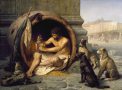
Defacing the Currency

Apparently there were some coins found from Sinope that were found to be vandalized.  However, there is no doubt that Diogenes wanted to perpetuate the story that he actually damaged the coins of his city of birth to protest authority and custom resulting in a trial and exile.
True or not, defacing the currency is an apt metaphor for the kind of life advocated by Diogenes.  He wanted to break through the hypocrisy of everyday thoughtless morality, display convention and habit as shallow, and upset the powerful and self-satisfied citizens of Athens.  I am reminded of the yippies of the 1960s and 1970s who lived simply, maybe in primitive communes like the hippies but sought to parody and poke at middle class, humdrum lives and pieties.  They would sponsor slum tours, only not of slums, but of middle class suburban neighborhoods showing the boring habits of people devoted to their lawns and Buicks.  Defacing the currency.  Unlike the yippie poseurs, Diogenes lived a life of sparse, natural existence and showed that he believed enough of his own philosophy to promote it be demonstration.  Here is a picture, one of many similar paintings, by Jean-Leon Gerome (from wikimedia commons) of Diogenes living in a jar, lighting the lantern he uses to search for one good man.  He is admired by a troop of dogs, who gave him the name of his philosophy, four fine looking Cynics.


Antisthenes at Closing Time

Antisthenes may have been a mentor to Diogenes and he is sometimes thought of as the original Cynic (at least by the Stoics).  Like Diogenes and his own teacher, Socrates, Antisthenes saw the pursuit of wealth to be a distraction and a corruption of wisdom.  He said he had a sufficiency for his physical needs and if he were feeling randy, then he could easily find a some woman for sex, since he wasn’t too choosy.

The Way of the Knife: The CIA, a Secret Army, and a War at the Ends of the Earth, Mark Mazzetti, 2013

Mark Mazetti’s The Way of the Knife is a war report, an accounting of the furious combat between the CIA and the Pentagon and the bloodshed that ensues.  During the Viet Nam War, the CIA acted as a secret military force that was partly responsible for the American involvement in that awful endeavor that was so tragic for all who were involved.  But after that, the CIA returned to its original mission of espionage and information.  September 11th changed that, and for the recent past the CIA has been doing the dirty work that the military cannot or will not do.  The military, constrained by law, regulation, experience and a sense of high honor and integrity does perform the dark arts of secret killings and drone attacks targeted by big data.  The raid on Abbotabad was carried out by Special Forces normally under the command of the Pentagon.  In the case of the killing of Osama Bin Laden, the Seal Team Six operation was “sheep-dipped”, that is, it was guided by the CIA which apparently has little in the way of civilian control over their nefarious deeds.  CIA staff are often attached to embassy staff in order to shield them from foreign laws of any kind.  That was the case of Raymond Davis, a CIA operative disguised as staff of the US Embassy in Pakistan.  He shot to death two persons in Pakistan who may or may not have been antagonists.  The tussle between the Pentagon and the CIA is long-standing, but the Nobel Peace Prize laureate, President Obama, has apparently sided largely with the virtually lawless CIA.  The NSA’s snooping operations seem like little to concern us when there is the CIA doing the bloody work.

Shakespeare’s Tremor and Orwell’s Cough, John J. Ross, M.D., 2012

The dominant literary theory in the 20th century was the New Criticism, which taught that text was all, that the life and times of the author had little importance to the appreciation of art.  Yet many readers ignore this too precious idea and assume that the writer is inspired by circumstances.  Biography can lead to a greater appreciation of the work.  In Dr. John Ross’ medical biography of a handful of great English authors, he accounts for some of the well known as well as the highly speculative details of their writing lives, occasionally reflecting on their works. Some of the details are TMI, far Too Much Information, especially in the descriptions of the treatments and poisonous potions given to these unfortunate sufferers.  Here are the literary victims and their maladies:
Shakespeare shook.  His handwriting became increasingly tremulous and some have surmised that he had syphilis or perhaps just a dose of the clap.  But his tremor is the only known fact of his diminished scrawl and who knows, this could have been age itself.  That his work frequently referenced venereal diseases is not evidence and neither is the difficult question of why he completely stopped writing at all.  We do learn from Ross that syphilis probably came to Europe from the Caribbean, brought back by Columbus’ crew and the other early explorers.  Perhaps this was only justice as the South Americans were gifted with smallpox and other Continental diseases.
John Milton was a pedantic and generally reprehensible SOB, but we knew that.  He may have had Asperger syndrome.  His blindness was probably caused by chronic glaucoma and retinal detachment related to severe myopia.  Ross confirms what your mother told you, that reading in low light ruins the eyes, or at least a lot of reading does.  Myopia is not common to pre-literate societies.  Lead poisoning may have also given Milton intestinal problems (he was “afflicted with flatulence”) and the deterioration of his kidneys.  The lead may have come from drinking vessels or from his physicians.  None of his physicians were able to make him a better person.
Jonathan Swift became dizzy and deaf, probably from Meniere’s disease.  He grew depressed, dull and demented.  No doubt he had OCD, he was obsessively clean, hated filth and was disgusted by sex.  This did not temper his love life with a Stella Johnson and Hester Vanessa Vanhomrigh, insisting on their fastidious cleanliness.  Some of the smutty passages in his writing may have been a result of his increasing dementia.  After his death, his fortune went to a hospital for the mentally ill which “now has wards named after Stella and Vanessa.”
The Bronte sisters and the whole sickly family suffered greatly from one awful thing or another.  The girls father, Patrick Brunty (he adopted the less ruffian name Bronte) was a literary but pious tyrant and a vicar who enforced his moral rules with a strong left hook.  He placed the famous Charlotte and Emily, together with the lesser known Maria and Elizabeth in a cruel Dickensian boarding school that was subsequently shut down for its vile and unhygienic conditions.  It did not close in time to save several of the girls from death by tuberculosis.  Both Maria and Elizabeth Bronte expired promptly and Charlotte and Emily went on to fame and the unfortunate life of chronic consumptives.  A brother, Branwell, took to the wilder side of life and drugs, from which he too died young.  Then there was Aspergers, depression, insomnia, hyperemesis, delirium, malnutrition, and possibly bipolar disorder.  The youngest of the sisters, Anne, an early feminist writer, “died peacefully” of tuberculosis.  Ross notes that Asperger syndrome may be conducive to the quiet, asocial life of a writer.  And in an aside, Dr. Ross discusses how cystic fibrosis, when only one of the recessive genes is present, may actually provide protection from tuberculosis.
Nathaniel Hawthorne had a social phobia that was extreme and no doubt pathological.  Attendant to this was depression and alcoholism.  His intense shyness led him to slight a visiting publisher, but then run after him as he left and he “shyly handed him a bundle of papers.”  This was the manuscript of The Scarlet Letter, one of the perennial contenders for Great American Novel.  Long a depressive but physically healthy for most of his life, Hawthorne began to decline in health and weight and energy and finally succumb, probably due to stomach cancer.
Herman Melville’s father suffered bipolar disorder leading to an acute breakdown called Bell’s mania and ultimately death.  Melville was no stranger to mental disorders and even Melvilles’s sons suffered likewise.  Melville writes of the debauchery and drunkenness among the sailors in the South Seas and may well have indulged in some of the same.  Wild and uninhibited sex is a not too subtle theme in his writing although there is no real evidence he engage in anything like physical love for Nathaniel Hawthorne his friend and neighbor to whom he clearly was enormously attracted. There is what must only be called a love letter to Hawthorne that has led to speculation about Melville’s most personal life, but there is no smoking gun.  His bipolar affliction resulted in maniacal bouts of writing for which the reading public can only be grateful.  Melville also suffered debilitating back pain attributed to rheumatism but which Dr. Ross contends must have been ankylosing spondylitis.  AS also could account for Melville’s eye affliction, chest pain and even loss in height.  All this assortment of ailments may well account for the gloomy writing.  He live long with his many illnesses but the one that killed him was heart failure.  After his death, Billy Budd was published, but of course, it was Moby Dick that places this long-suffering author in the first rank of novelists in the English language.
William Butler Yeats suffered much from his lungs and had the kind of heart trouble that leads to the agonies of the lovelorn the most compelling of poetry.  It was his heart the finally did him in, dying of heart failure, “his wife and two mistresses in attendance.”    Like Dante and Beatrice, Yeats forever loved his Maude Gonne, who repeatedly spurned his marriage proposals, as did Maude Gonne’s daughter.  Yeats did marry the loyal Georgina Hyde Lees, a friend of Ezra Pound.  The young American Ezra Pound was a genius poet who worshipped the elder poet.  Yeats frequently lived with Pound in Italy, until madness and cynicism turned Ezra Pound into a fascist and traitor.  Brucellosis was the worst of the ailments for Yeats, if love-sickness does not count.  Caused by a bacterium transmitted through contaminated milk, brucellosis is a devastating lung disease that was difficult to treat before the age of antibiotics.  Yeats was treated with arsenic, a valuable remedy for infections known from ancient Greek times and is still used in veterinary medicine.  Yeats may have had a bit too much of the stuff and had a slow recovery.  He also voluntarily endured a “Steinach procedure”.  Steinach, a wacko charlatan, gave patients what was only a vasectomy, which he apparently convinced his dupes would restore the youthful vigor of their manly parts.   Surely Yeats had enough troubles without this, but the poor Irish patriot wrote some of the most moving and transcendent poetry in the English language.
On the other hand, there are those who consider Jack London a hack who wrote a couple of worthy stories.  Nonetheless, London became enormously popular and quite rich.  Jack London was bipolar and his maniacal bouts of energy produced volumes of rip-roaring adventure stories.  On one of his own adventures in the Solomon Islands, London contracted yaws, a disease that is a first-cousin to syphilis but can be contracted by only casual contact.  He suffered from terrible skin ulcers, a rectal fistula, and from the regimen of the attempted cure:  arsenic and mercury.  As a wealthy celebrity writer, physicians would prescribe for him most anything.  For later ailments, in addition to the toxic mercury, but possibly effective arsenic, London was given heroin, strychnine, belladonna, and a plethora of other snake oils.    He died of an overdose.
James Joyce had a dose of the gleet.  The clap.  Gonorrhea.  Neisseria gonorrhoeae.  The description of the symptoms, and worse, the treatment, is given by Dr. Ross, but not to be repeated here.  Joyce apparently took the cure for this awful malady and survived unscathed.  He may also have contracted chlamidia resulting in reactive arthritis.  Reactive arthritis, triggered by the genital infections is an autoimmune disease. This in turn may have triggered his iritis, an inflammation of the iris.  This became chronic and led to his near blindness.  What was the treatment?  Do you want to know?  Yes, he was treated with leeches applied to the eye.  During the writing of one of the greatest of literary feats, the magnificent Ulysses, his afflicted eyes worsened with severe glaucoma.  Ross reports that frequently in Ulysses, many passages refer to the aforementioned gleet and other STD manifestations. Joyce’s eyes continued to worsen, and he had to suffer the repeated cruelties of ocular surgeries.  What did the great wordsmith in at last was acute peritonitis.  Ross relates a doubtful anecdote, but one that rings so true about Joyce and his lifelong argument with Irish Catholicism.  A priest offered to give Joyce a church requiem and burial, but the writer’s wife Nora said, no, “I couldn’t do that to him.”
George Orwell had a bad cough.   Trouble with breathing, congestion, and bronchitis began to bedevil Orwell, born Eric Blair in 1903, as early as infancy.  He had a brilliant academic career but being decidedly among the common classes in snooty England, he took on the role of a policeman in Burma.  His weak lungs suffered in the East and he only worsened his condition upon an early retirement by a Bohemian lifestyle as scruffy writer in London.  Here he was given to fits of coughing up blood, attacks of pneumonia, and later tuberculosis.  The cruelties of his venture in fighting the fascists in the Spanish civil war did not help.  He took a bullet to the neck in that war and miraculously survived.  His incessant smoking could not have helped either.  When the world war came to England in 1940, the adventurous socialist volunteered his services, but of course, he failed his physicals.  Ross provides copious details of Orwell’s failing health, including various gruesome descriptions, which probably ought to be skipped by the squeamish.  No doubt Orwell’s suffering was not only from his diseases, but from the awful medical procedures which may have inspired some of the torture and institutional cruelties in Nineteen Eighty-four.  The critical and financial success of that novel came too late in life for Orwell as he was already dying.  He enjoyed a brief reprieve from his impending end, and sought to take a rest in the Swiss Alps but before his flight was to leave he died alone in the hospital, a gloomy genius to the last.  

How to Read a Poem, Edward Hirsch

Recently I heard an NPR report that poetry had been given a new life and new popularity with the internet, with YouTube, public readings, poetry slams, and even apps (yes, I love the app from Poetry magazine).  Years ago, as an English major in college, I read numerous books and reviews that discussed poetry almost as if it were some sort of rare earth or a tarnished but cherished antique, appreciated only by the few.  In How to Read a Poem, Edward Hirsch celebrates the lyric poem as if it were a compelling song, an ode to life itself, a toast to the ecstasy and sorrow of the world.
The lyric poem is the poem of the song, with rhythm kept on the lyre, and words wrung from the heart.  It is of course the same word, lyric, we use for the words of a song and with the same purpose: to heighten and deepen the emotional experience.  No critic I read in those years of college expressed a greater emotional attachment to poetry than Hirsch, who relates not just the construction of the poem itself, but of his powerful reaction to it.  
Hirsch says that at the most critical level, the lyric poem depends on metaphor.  It is as if we really cannot explain a deep human emotion with ordinary words but must turn to symbolic language.  A poem is a song, a poem is ship on the ocean of time, the first cry of a newborn child, the smile of a grandmother, the long shadow of an Autumn evening, a minuet and a dirge.  
This book is particularly useful in its examination of the poetry of Europe and the South American poets.  The author introduced me to the “Postcards” of Miklos Radnoti, the final one, so tragic, written as he takes his last painful steps toward execution and found in his cloak next to his heart.  His love of Pablo Neruda and his affecting response to this poetic master is fresh and delightful. The erudite Robert Graves claimed that the metrics of Anglo-Saxon poetry (the topic of my Master’s thesis) was sung with the rhythms of the oar in water.  
He helped me understand Wallace Stevens, always somewhat recondite yet captivating.  Hirsch makes obvious his great love for Walt Whitman who loved America so well and the American people that he left us with a body of work that speaks to the unique soul of the people of the New World. The love for poetry of Hirsch is inspiring and he subtitles How the Read a Poem as …And Fall in Love with Poetry.  Certainly Edward Hirsch, and I suppose his readers, are deep in that love. 

The Life You Save May Be Your Own, Paul Elie. 2003

When I was a Graduate Teaching Assistant in the English Department (Miserable Job # 24 maybe, but really miserable), one of the assigned stories was Flannery O’Connor’s A Good Man is Hard to Find.  The students found the story disturbing as I always did.  Undoubtedly O’Connor meant to discomfit the story readers and force them, as if by gunpoint, to examine their lives and perhaps to save it from a life unexamined and in the dark.  The misfits in her stories were dragged up from her own discomfit in her parochial South and her personal torment.

Along with Walker Percy, Dorothy Day, Thomas Merton, all Catholic writers of the 1950s and 1960s, Flannery O’Connor and her life and work are examined in a history and biography of the four seekers of salvation, Paul Elie’s The Life You Save May Be Your Own.  Perhaps none really found it, but their search became the common currency of the turbulent times where American attitudes toward war, religion, race, and power were in turbulence.  The Life You Save May Be Your Own looks at the major writing of these four literary and social change agents.  This is not traditional literary criticism, certainly not the critical outlook that dismisses the life of the writer as unimportant to the work.  Rather, the social milieu and the very personal lives of each of the writers is examined with a sharp eye.  Passing through the lives of the four writers and brought into focus in this book are many of the thoughtful and prominent religious and social activists of the age.  In some way these writers knew, influenced and were affected by the Dalai Lama, Mother Theresa, the Berrigan Brothers,  Pope John XXIII, Shelby Foote, Evelyn Waugh, as well as the civil rights workers, beat poets, peace activists, hippies, poverty workers, and other social advocates of change.  Mostly, as all four taught us, change always comes from within.